

Gibbons, G. (1997). The reasons for seasons. Boston, MA: National Brailee Press.
Summary: Why is there winter in the Southern Hemisphere at the same time there is summer in the Northern Hemisphere? In summertime, why is it still light out in the evening? With simple language appropriate for young readers, non-fiction master Gail Gibbons introduces young readers to the four seasons and explains why they change throughout the year. https://www.goodreads.com/book/show/175526.The_Reasons_for_Seasons
Age Range: 4-8 years
Justification: This book could be used as an introduction to the weather or used to help students understand what it is like in different parts of the world. This book would work with this standard because, it requires students to make connections about the weather in two different parts of the world by telling how they are similar and how they are different:
CCSS.ELA-LITERACY.RI.1.3
Describe the connection between two individuals, events, ideas, or pieces of information in a text.
Review: Fascinating and easy to understand, this is a perfect introduction to seasons, earth’s orbit, and axial tilt. Different effects on different parts of the world are included, illustrating the difference in climate between the equator, the northern and southern hemispheres, and the polar regions. https://www.goodreads.com/book/show/175526.The_Reasons_for_Seasons

Schreiber, A. (2013). Penguins!Washington, D.C.: National Geographic.
Summary:
This book introduces children to the world of penguins, with photographs and fun facts offering information on their behavior, physical characteristics, and habitats. https://www.scholastic.com/teachers/books/national-geographic-reader-lvl-2-penguins-by-anne-schreiber/
Age Range: 5-7 years
Justification: This book can be used to give children some information about these animals. If there is a child in your classroom who has a specific interest in penguins this would be a good book to give them. This book works with this standard because, it has different headings and captions that can be used to teach children what they do in a text:
CCSS.ELA-LITERACY.RI.1.5
Know and use various text features (e.g., headings, tables of contents, glossaries, electronic menus, icons) to locate key facts or information in a text.
Review: They waddled into stardom in National Geographic’s March of the Penguins film. These guys are now nature’s ROCK STARS! If you’re age 5, you’re probably as tall as an Emperor. But why do they throw up so much? March this way, and find out all! https://www.goodreads.com/book/show/7042907-penguins
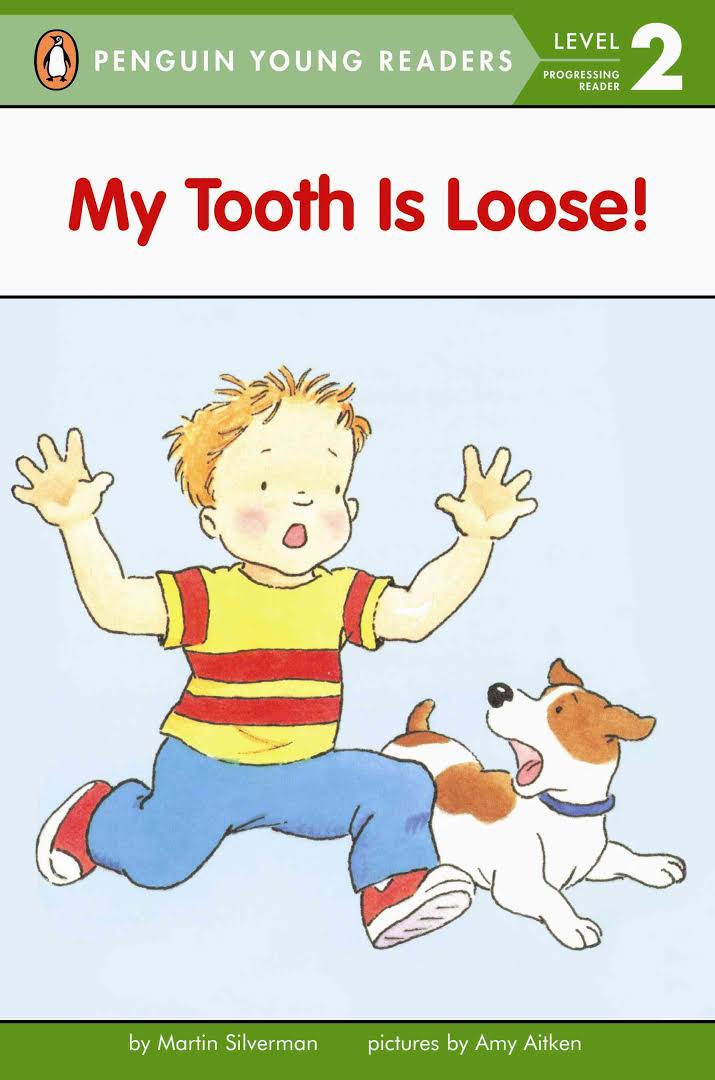
Silverman, M. (1994). My tooth is loose! New York City, NY: Penguin Young Readers
Summary: Georgie has a loose tooth, but he’s not sure how to pull it out. His friends offer advice – like tying a string to it – but Georgie doesn’t like their ideas. In the end, his tooth falls out on its own. https://www.goodreads.com/book/show/1257992.My_Tooth_Is_Loose_
Age Range: 4-7 years
Justification: This would be a good book to read to students when the very first student in your class looses their tooth. This book teaches children that it is perfectly normal to loose their teeth. This standard would work with this book because, it requires students to pay attention to the book so the learn the important aspects of losing their teeth.
CCSS.ELA-LITERACY.RI.1.2
Identify the main topic and retell key details of a text.
Review: I like this book because every child can relate to it. I would read this book if one of my students had a loose tooth or if I had a health unit. This book is a level one reading level book suitable for ages 4 to 7. http://www.librarything.com/work/1163908/reviews/101797746

Carney, E. (2012) Planets. Washington, D.C.: National Geographic
Summary: This brilliantly illustrated book taps into children’s natural curiosity about the vast world of space. This level two reader, written in simple language that is easy for young readers to understand, introduces children to our solar system, including all of the planets and dwarf planets, and lots of fascinating fun facts. This reader helps cultivate the explorers of tomorrow! https://www.goodreads.com/book/show/13330418-planets
Age Range: 5-7 years
Justification: This book would be a good introduction or refresher into the solar system. It provides basic information of how the solar system is set up. This standard would work best for this book because, there are multiple pictures in the book students can get information from.
CCSS.ELA-LITERACY.RI.1.7
Use the illustrations and details in a text to describe its key ideas.
Review: This high-interest, educationally vetted series of beginning readers features the magnificent images of National Geographic, accompanied by texts written by experienced, skilled children’s book authors.
https://www.goodreads.com/book/show/13330418-planets

Gibbons, G. (1991). From Seed to Plant. New York City, NY. Holiday House
Summary: With simple language and bright illustrations, non-fiction master Gail Gibbons introduces young readers to the processes of pollination, seed formation, and germination. Important vocabulary is reinforced with accessible explanation and colorful, clear diagrams showing the parts of plants, the wide variety of seeds, and how they grow. The book includes instructions for a seed-growing project, and a page of interesting facts about plants, seeds, and flowers. A nonfiction classic, and a perfect companion for early science lessons and curious young gardeners. https://www.goodreads.com/book/show/241088.From_Seed_to_Plant
Age Range: 4-8 years
Justification: This book can be used in science as an introduction to seeds and plants. This is a fun way to get children interested in the life cycle of a plant. You could use this standard for this book to gauge students understanding of the vocabulary in the book:
CCSS.ELA-LITERACY.RI.1.4
Ask and answer questions to help determine or clarify the meaning of words and phrases in a text
Review: Straightforward book describing the life cycle of a plant. Detailed illustrations show the parts of a flower and what’s going on inside the seed we plant.
https://www.goodreads.com/book/show/241088.From_Seed_to_Plant

