

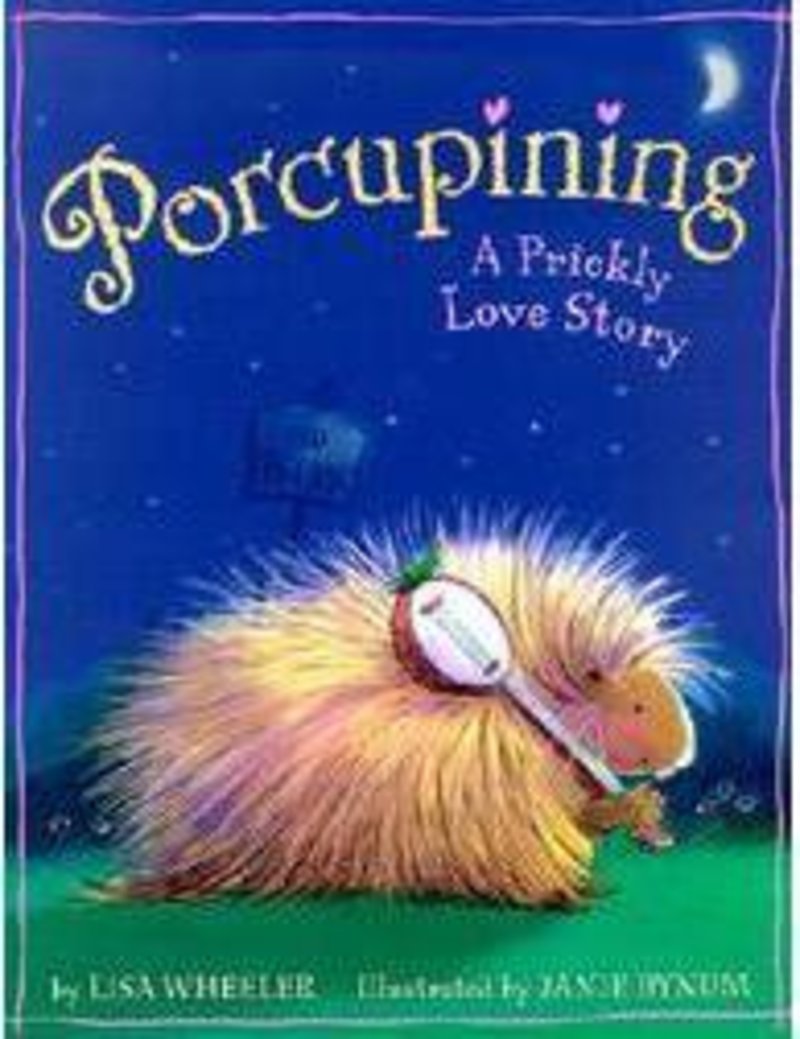
Wheeler, L., & Bynum, J. (2002). Porcupining: A prickly love story. Boston: Little, Brown.
Summary: What could be more poignant than a porcupine pining for a companion? With pun-filled prose and pleasing pictures, this passionate tale of love and friendship between two prickly creatures in a petting zoo makes a perfect read aloud (and a sublime Valentine). https://www.goodreads.com/book/show/1392352.Porcupining
Age Range: 5-8 years
Justification: This book has a lot of alliteration and puns in it. During this age range most children enjoy animal books, so it is usually a big hit in the classrooms. You could use this book for this standard to gauge the children’s understanding of the different characters and settings used throughout the book:
CCSS.ELA-LITERACY.RL.1.3
Describe characters, settings, and major events in a story, using key details.
Review: “Amusing watercolor and pastel illustrations perfectly accompany this silky smooth romance. (Picture book. 4-8). https://www.kirkusreviews.com/search/?sf=r&q=porcupining
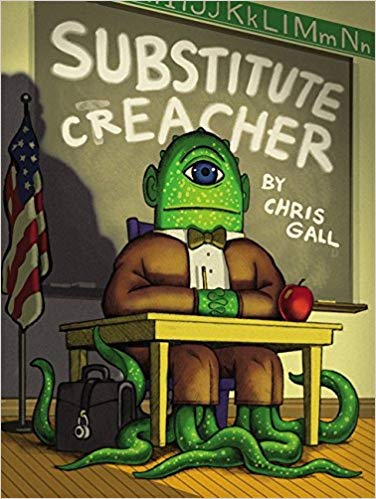
Gall, C. (2013). Substitute Creacher. Toronto: CNIB.
Summary: The troublemaking students of Ms. Jenkins’ class arrive at school one day to discover a substitute creacher has come to put a stop to their monkey business! He regales them with mind-boggling stories about his former students who didn’t follow the rules: Keith the glue-eater, Zach the daydreamer, and Hank the prankster, to name a few. But even this multi-tentacled, yellow-spotted, one-eyed monster’s cautionary tales about the consequences of mischief-making can’t seem to change the students’ wicked ways until he reveals the spookiest and most surprising story of all: his own. https://www.goodreads.com/book/show/9419182-substitute-creacher
Age Range: 4-8 years
Justification: This book could be used at the beginning of the school year or right before you know your students will have a substitute teacher. This is a great way to show them how they should be acting in the classroom with a substitute, or even with their normal teacher. This would be a good book to use with this standard because, you can ask the students what the characters were doing wrong or how they should really be acting:
CCSS.ELA-LITERACY.RL.1.1
Ask and answer questions about key details in a text.
Review: Great for both Halloween and the start of a new school year, this is certain to provide more than a few laughs to kids who have seen through Viola Swamp’s disguise. https://www.kirkusreviews.com/search/?sf=r&q=Substitute+Creacher
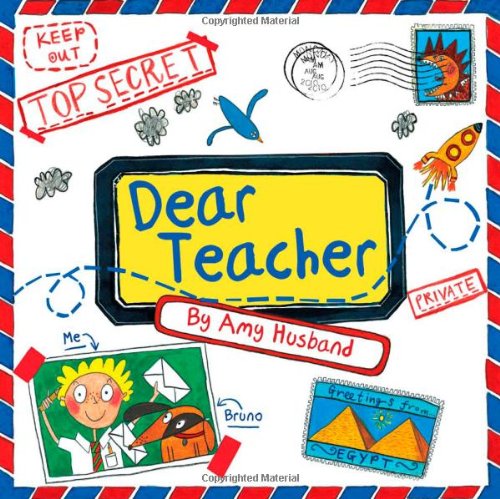
Husband, A. (2010). Dear teacher. Naperville, IL: Sourcebooks Jabberwocky.
Summary: Dear Teacher is a hilarious collection of letters from Michael to his new teacher explaining why he can’t go to class. From traveling to the pyramids of Egypt to getting attacked by pirates and going to the moon in a rocket ship, each letter is increasingly outlandish and covered with Michael’s incredibly funny sketches from his many “adventures.” When Michael’s teacher writes back telling him how sorry she is he’ll miss all of the exciting school activities planned for the year, Michael realizes all the fun he’d really miss out on. https://www.goodreads.com/book/show/8430615-dear-teacher
Age Range: 4-8 years
Justification: This book could be used to help children realize that school is not that scary. This would be a good book to read at the beginning of the school year to help children understand some of the things they could be doing that year. You could use this standard to get the students to examine Michael’s feelings about school from the pictures or words in the book:
CCSS.ELA-LITERACY.RL.1.4
Identify words and phrases in stories or poems that suggest feelings or appeal to the senses.
Review: In this vertically oriented book, Michael and his dog, Bruno, travel from Egypt to the moon, down the Amazon and up Mount Everest, all while sending letters to Michael’s new teacher, Miss Brooks, to explain his anticipated lateness on the first day of school (“NASA wants me to go on a space mission…. I told them about the math tests, but they said that the future of the planet has to come first”). But when Michael receives a reply reminding him what he’ll miss, he may just decide to give school a try. Husband’s bright, doodle-like illustrations and dynamic letters will help readers realize real-life escapades can be as fun as imaginary ones. https://www.publishersweekly.com/978-1-4022-4268-7
Daywalt, D. (2016). Day the crayons quit. New York City, NY: Philomel Books.
Summary: Poor Duncan just wants to color. But when he opens his box of crayons, he finds only letters, all saying the same thing: We quit! Beige is tired of playing second fiddle to Brown. Blue needs a break from coloring all that water, while Pink just wants to be used. Green has no complaints, but Orange and Yellow are no longer speaking to each other. What is Duncan to do? https://www.goodreads.com/book/show/16101018-the-day-the-crayons-quit
Age Range: 3-7 years
Justification: This book could be used to give students ideas of different ways to use their crayons. This could also be a good way to involve students in thinking about things like personification. Since this book talks about the different opinions of each crayon you could incorporate the following standard by having students compare and contrast each crayons experience.
CCSS.ELA-LITERACY.RL.1.9
Compare and contrast the adventures and experiences of characters in stories.
Review: A comical, fresh look at crayons and color. (Picture book. 3-7)” https://www.kirkusreviews.com/book-reviews/drew-daywalt/day-crayons-quit/
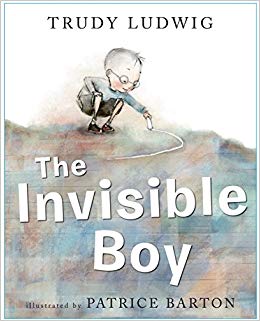
Ludwig, T., & Barton, P. (2013). The invisible boy. New York: Alfred A. Knopf.
Summary: Meet Brian, the invisible boy. Nobody ever seems to notice him or think to include him in their group, game, or birthday party … until, that is, a new kid comes to class. When Justin, the new boy, arrives, Brian is the first to make him feel welcome. And when Brian and Justin team up to work on a class project together, Brian finds a way to shine. https://www.goodreads.com/book/show/17140549-the-invisible-boy
Age Range: 6-9 Years
Justification: This book would be a great way to talk to students about making new friends in the classroom. It could also be a way to help them realize that if they are feeling lonely, there is a good chance they aren’t the only ones feeling this way. In this book the illustrations play a major role in the story. Due to this, the following standard would align very well with this text:
CCSS.ELA-LITERACY.RL.1.7
Use illustrations and details in a story to describe its characters, setting, or events.
Review: Accessible, reassuring and hopeful. (Picture book. 5-7) https://www.kirkusreviews.com/search/?sf=r&q=the+invisible+boy
 Amber's Literacy Academy